
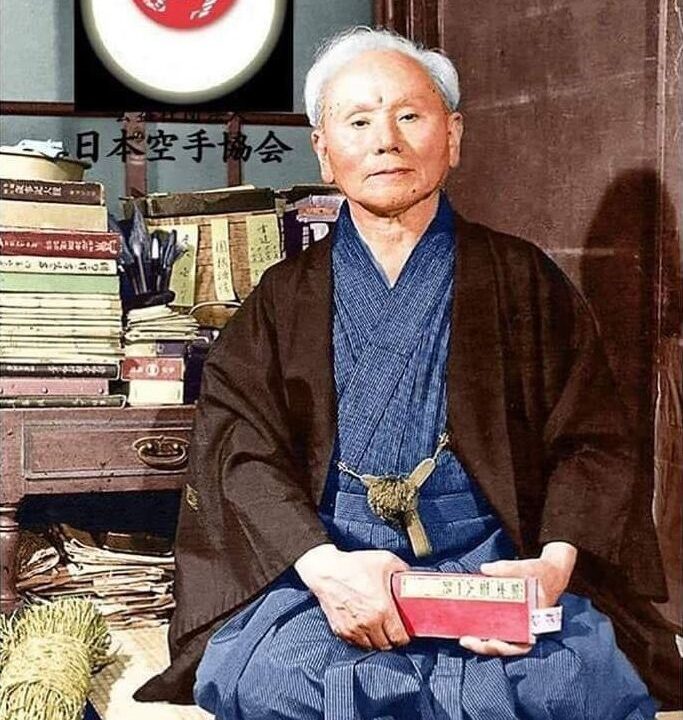
Gichin Funakoshi (1868–1957) is revered as the founder of modern karate and the creator of the Shotokan style, the world’s most widely practiced form of traditional karate. Through his dedication, wisdom, and lifelong pursuit of self-improvement, he transformed karate from a little-known Okinawan fighting art into a disciplined, philosophical way of life that is now studied across the globe.
Born on 10 November 1868 in Shuri, Okinawa, Gichin Funakoshi grew up during a period of great cultural change. At that time, karate was an art practiced in secrecy, passed quietly between master and student. From an early age, Funakoshi displayed an interest in both literature and martial discipline, reflecting the balanced nature of his later teachings — a harmony between body, mind, and spirit.
He studied under two of Okinawa’s greatest masters, Anko Azato and Anko Itosu, both of whom had deep connections to the traditions of Shuri-te and the samurai class. From Azato, Funakoshi learned precision, patience, and the importance of moral integrity. From Itosu, he inherited the concept of spreading karate as a means of education and self-development rather than as a tool for combat. These influences shaped his philosophy that karate’s highest purpose was the cultivation of character.
In 1922, at the age of 54, Funakoshi was invited to Tokyo by Japan’s Ministry of Education to demonstrate Okinawan karate at the First National Athletic Exhibition. The demonstration was a success, sparking great interest among the Japanese public. Encouraged by this response, Funakoshi decided to remain in Japan to teach and promote karate full-time. This marked the beginning of his lifelong mission: to establish Karate-do — “The Way of Karate” — as a respected discipline and moral practice. Funakoshi worked tirelessly to adapt and refine karate for a broader audience. He simplified kata to make them accessible to students, emphasized proper etiquette and philosophical understanding, and replaced the Okinawan term “karate” (meaning “Chinese hand”) with the characters meaning “empty hand” (空手). This subtle yet profound change symbolized his vision of karate as a path of purity, self-control, and non-aggression.
His teaching style focused on humility, precision, and the development of inner strength. He discouraged displays of arrogance or violence, often reminding students that true karate is not found in the fist, but in the heart. Funakoshi’s words, “The ultimate aim of karate lies not in victory or defeat, but in the perfection of the character of its participants,” became the defining principle of Shotokan philosophy.
In 1936, with the help of his students, Funakoshi opened his first official dojo in Tokyo. They named it the Shotokan — “Shoto” being Funakoshi’s pen name, meaning “pine waves”, and “kan” meaning “hall”. The name reflected his love of nature and his poetic spirit. From this humble beginning, the Shotokan dojo became the foundation for what would evolve into one of the most influential martial arts in the world.
Beyond his technical teachings, Funakoshi placed immense value on the moral and spiritual dimensions of karate. He taught that the practice must begin and end with respect — “Rei ni hajimari, rei ni owaru” — and that mastery of technique was meaningless without mastery of one’s own emotions. His emphasis on courtesy, humility, and perseverance shaped karate into a means of self-cultivation rather than mere self-defense.
Funakoshi also contributed to karate through his writings. His books, including Ryukyu Kempo: Karate (1922), Karate-do Kyohan (1935), and his autobiography Karate-do: My Way of Life (1956), remain essential reading for practitioners worldwide. These works captured not only his techniques but his philosophy — a belief in lifelong learning, moral integrity, and peace through discipline.
In his later years, Funakoshi continued to teach and write, even as his health declined. He never sought fame or recognition, preferring to live modestly and let his students carry his art forward. He passed away in Tokyo on 26 April 1957, at the age of 88. Two years later, the Japan Karate Association (JKA) was formally established to preserve and promote his teachings, ensuring that his legacy would endure for generations to come.
Today, Gichin Funakoshi’s influence can be felt in nearly every dojo in the world. His principles — humility, respect, discipline, and compassion — form the spiritual foundation of karate practice. His message continues to inspire millions: that the true purpose of karate is not to conquer others, but to conquer oneself.
Legacy: Gichin Funakoshi’s teachings continue to shape the moral and technical foundations of Shotokan Karate. His emphasis on humility, respect, and lifelong self-improvement remains at the heart of karate-do today. Every dojo that upholds these values stands as a living tribute to his vision and spirit.